
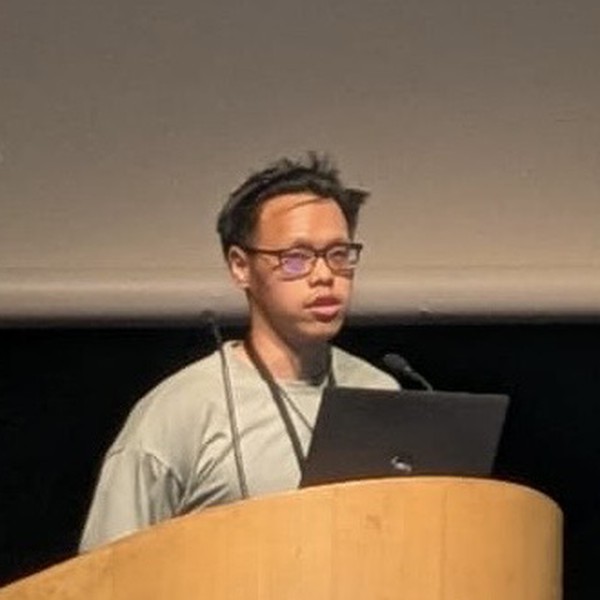
About
I am a PhD student at LPSM, Sorbonne University, and Google DeepMind, working on diffusion models and machine learning theory.
- Advisors
- Gérard Biau, Claire Boyer and Pierre Marion
- At Google DeepMind
- Quentin Berthet and Romuald Elie
News
- New preprint: Statistical Geometry of Group Actions: Symmetry, Transport, Estimation, a Lie-theoretic framework for symmetry and unbiasedness in variational inference, with Quentin Berthet, Peter Bartlett and Romuald Elie.
- New preprint: AlphaProtein Novo, a generative diffusion pipeline for de novo enzyme design on new-to-nature chemistry and non-natural substrates, with colleagues at Google DeepMind and Caltech.
- Two papers accepted at NeurIPS 2026: Understanding diffusion models requires rethinking (again) generalization (position track) and MIND.
- New preprint: Kastor, an efficient fine-tuning strategy for generative emulation of PDE simulations, with colleagues at Google DeepMind.
- The DiffusionGemma technical report is out: an open-weight discrete-diffusion language model obtained by fine-tuning Gemma 4.
Research focus
Generalization in diffusion models
Why diffusion models produce novel samples rather than copies of their training data, and how optimization shapes this.
Rethinking generalization · Optimal Stopping · Taking a Big Step
All 3 papersSampling and evaluation
When to stop the reverse process in latent diffusion models, and how to measure sample quality reliably.
All 2 papersGenerative models for science and language
De novo enzyme design, generative emulators for PDE simulations, and discrete-diffusion language models.
AlphaProtein Novo · Kastor · DiffusionGemma
All 3 papersMathematical foundations & regularization
How distributional symmetry governs variational inference, and how optimization biases deep residual networks and score matching.
Statistical geometry · Taking a Big Step · ResNets and neural ODEs
All 5 papersSelected publications
arXiv preprint · 2026
Kastor: An efficient fine-tuning strategy for generative emulation of PDE simulations
Fine-tunes a deterministic physics foundation model into a fast, accurate generative PDE emulator.
- Problem. Autoregressive ML emulators of PDEs accumulate error over long horizons and miss the stochasticity of physical systems.
- Approach. Adapt a deterministic physics foundation model into a generative surrogate with two-stage inference, mean-prediction regularization and spatial gradient matching.
- Result. 42.9% average reduction in forecasting error over the Walrus fine-tuning baseline on The Well, better on 8 of 10 datasets.
NeurIPS 2026 position track
Understanding diffusion models requires rethinking (again) generalization
Generalization in diffusion models needs new theory: what is learned before memorization?
- Problem. In diffusion models memorization and generalization are incompatible, so the supervised-learning theory of generalization does not transfer.
- Approach. Survey the three families of explanations and run controlled CIFAR-10 sweeps over dataset size, model size, batch size and learning rate.
- Position. Why models do not memorize is largely settled by early stopping and the linear scaling of memorization time; what is learned before memorization is the open question.
ICML 2026 Oral at the PriGM workshop, EurIPS 2025
Optimal Stopping in Latent Diffusion Models
Why the last denoising steps of a latent diffusion model can hurt, and when to stop.
- Problem. The last steps of latent diffusion can degrade samples, which does not happen in pixel-space diffusion.
- Approach. A Gaussian model with linear autoencoders that links latent dimension, the constraints of score matching and the stopping time.
- Result. Low-dimensional latents call for earlier stopping, high-dimensional ones for later; stopping time is a key hyperparameter of latent diffusion.
COLT 2025
Taking a Big Step: Large Learning Rates in Denoising Score Matching Prevent Memorization
Large learning rates implicitly regularize denoising score matching and prevent memorization.
- Problem. The exact minimizer of denoising score matching memorizes the training data, yet trained models memorize only mildly.
- Approach. Analyze gradient descent with large steps, which can only converge to minima whose sharpness is bounded by the inverse learning rate.
- Result. The memorizing solution is too sharp to be reached; large learning rates prevent memorization.