NeurIPS 2026
MIND: Monge Inception Distance for Generative Models Evaluation
A sliced-Wasserstein alternative to FID: more sample-efficient, faster, and more robust.
In brief
- Problem. FID needs tens of thousands of samples and can be fooled by matching moments.
- Approach. A sliced Wasserstein distance between Inception features, computed by sorting one-dimensional projections, with no high-dimensional means or covariances to estimate.
- Result. An order of magnitude more sample-efficient, two orders of magnitude faster, more robust; 5k samples match FID at 50k.
Abstract
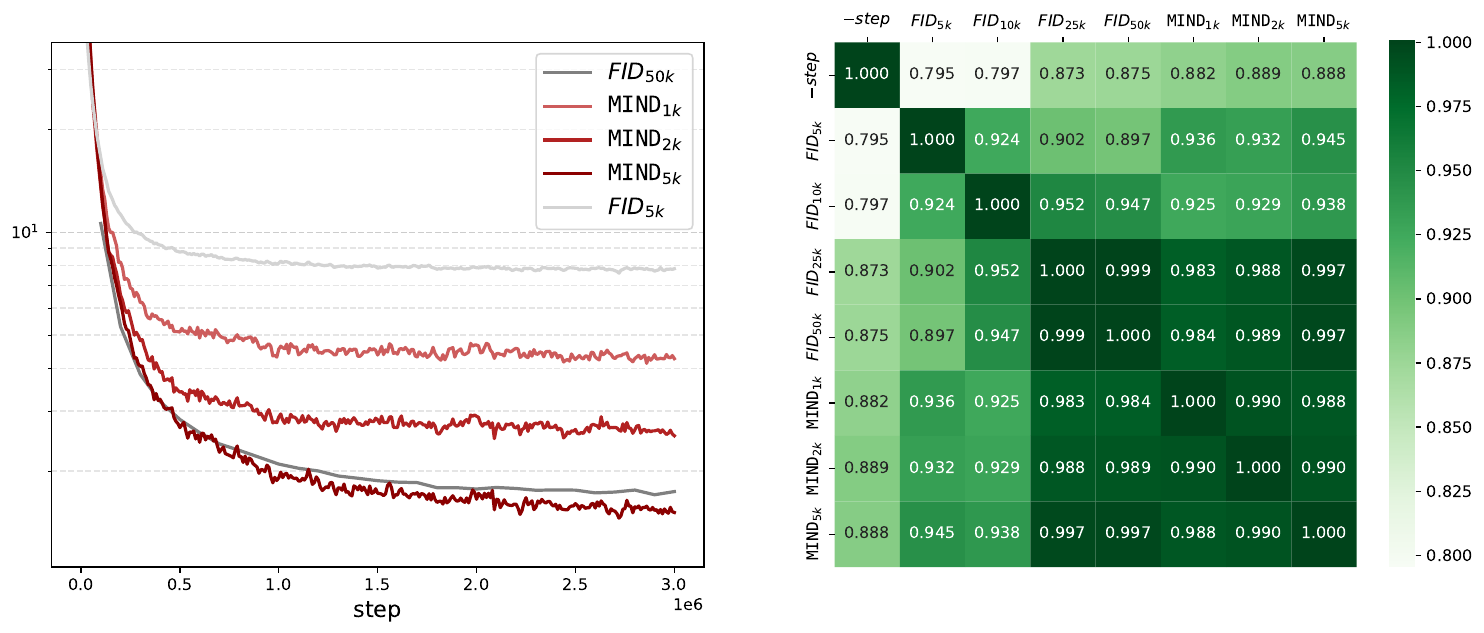
We propose the Monge Inception Distance $\texttt{MIND}$, a metric for evaluating generative models that addresses key limitations of the widely adopted Fréchet Inception Distance (FID). $\texttt{MIND}$ metric leverages the sliced Wasserstein distance to compare distributions by averaging one-dimensional optimal transport distances, efficiently computed via sorting. This approach circumvents the estimation of high-dimensional means and covariance matrices, which underlie FID’s poor sample complexity and vulnerability to adversarial attacks. We empirically demonstrate three primary advantages: (i) it is more sample-efficient by one order of magnitude, (ii) it is faster to compute by two orders of magnitude, (iii) it is more robust to adversarial attacks such as moment-matching. We show that $\texttt{MIND}$ with 5k samples can replace the evaluation performance of FID with 50k samples, providing high correlation with this standard benchmark and superior discriminative performance. We further demonstrate that even smaller sample sizes (e.g., 1k or 2k) remain highly informative for rapid model iteration.
Cite
Quentin Berthet, Yu-Han Wu, Clément Crepy, Romuald Elie, Klaus Greff and Michael E. Sander (2026). MIND: Monge Inception Distance for Generative Models Evaluation. arXiv:2605.06797.
@misc{berthet2026mind,
  title={{MIND}: Monge Inception Distance for Generative Models Evaluation},
  author={Berthet, Quentin and Wu, Yu-Han and Crepy, Cl{\'e}ment and Elie, Romuald and Greff, Klaus and Sander, Michael E.},
  year={2026},
  eprint={2605.06797},
  archivePrefix={arXiv},
  primaryClass={cs.LG}
}