

arXiv preprint · 2026
Statistical Geometry of Group Actions: Symmetry, Transport, Estimation
A Lie-theoretic framework for how distributional symmetry governs unbiasedness and bias in variational inference.
In brief
- Problem. Even under model misspecification, when does variational inference still recover structural parameters of a symmetric target distribution?
- Approach. Analyze the conjugation action of a compact symmetry group H on a transport Lie group G and its induced adjoint representation on the transport Lie algebra.
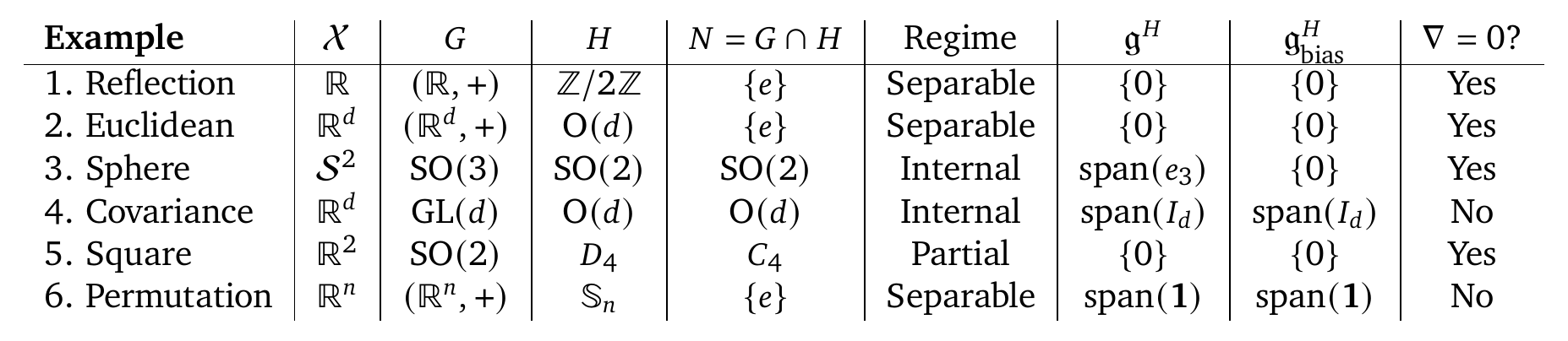
- Result. The KL Riemannian gradient lies in the H-trivial subspace, decomposing the Lie algebra into identifiability, bias, and symmetry-breaking subspaces, with a Stein-type moment-matching condition that eliminates residual bias.
Abstract
We study variational inference in the presence of distributional symmetry, focusing on the interaction between two distinct group actions on a sample space: a symmetry action that leaves a reference distribution invariant, and a transport action that generates a parametric variational family by pushforward. By analyzing the algebraic structure of the total transformation group generated by both actions and the induced adjoint representation of the symmetry group on the transport Lie algebra, we establish that the Riemannian gradient of the Kullback–Leibler (KL) divergence at the true transport parameter is constrained to lie in the trivial representation of the symmetry group. Consequently, symmetry forces the gradient to vanish along all non-trivial representations. Combining this representation-theoretic constraint with parameter identifiability yields an orthogonal decomposition of the transport Lie algebra into three interpretable subspaces: an identifiability kernel (along which the objective is locally constant), a bias subspace (where the gradient may be nonzero due to model misspecification), and a symmetry-breaking subspace (where the gradient is forced to vanish by symmetry alone). Finally, we characterize the residual bias directions in terms of distributional mismatch between the base model and the standardized target, and derive an explicit Stein-type moment-matching condition that eliminates this bias, extending the location-scale results of Margossian and Saul (2025) to general Lie group transformation families.
Cite
Quentin Berthet, Peter Bartlett, Romuald Elie and Yu-Han Wu (2026). Statistical Geometry of Group Actions: Symmetry, Transport, Estimation. arXiv:2611.10111.
@misc{berthet2026statistical,
  title={Statistical Geometry of Group Actions: Symmetry, Transport, Estimation},
  author={Berthet, Quentin and Bartlett, Peter and Elie, Romuald and Wu, Yu-Han},
  year={2026},
  eprint={2611.10111},
  archivePrefix={arXiv},
  primaryClass={math.ST}
}